

What is an Emotional Healing Coach? A Guide to Clarity and Freedom
- Martyn Eggington
- May 15
- 12 min read

What if the persistent guilt you feel regarding family boundaries isn't a sign of failure, but a symptom of being tethered to expectations that were never yours to meet? You might find yourself constantly managing the emotions of others, feeling confused about your identity amongst competing family roles, or struggling to say no without an impending sense of drama. It's a cycle that feels heavy, exhausting, and permanent.
You deserve a space where your internal security is the priority rather than an afterthought. An emotional healing coach acts as a practical guide and impartial ally, providing a process that is safe, objective, and supportive. This article explores how professional coaching helps you navigate complex dynamics and relinquish external emotional burdens. We'll outline the journey toward mental and emotional transparency, distinguishing this work from clinical psychotherapy whilst focusing on your personal fulfilment. You will learn how to set boundaries without debilitating drama and reclaim a sense of personal autonomy that feels grounded, clear, and free.
Key Takeaways
Understand how an emotional healing coach serves as a professional partner to help you process deep-seated patterns and reclaim your personal autonomy.
Learn to recognise the "invisible tethers" of family expectations and chronic guilt that often dictate your daily behaviour and emotional state.
Discover the distinction between coaching and clinical therapy, specifically how a future-oriented approach helps you move past feeling stuck.
Explore the structured path to mental lucidity and the vital process of relinquishing emotional burdens that are not yours to carry.
Identify the most effective format for your transformation, from the focus of 1:1 sessions to the flexibility of online coaching via Zoom.
Table of Contents
What is an Emotional Healing Coach?
Do you ever feel as though you are carrying the weight of an entire family's history on your shoulders? An emotional healing coach is a professional partner who guides you through the intricate process of identifying and dismantling deep-seated emotional patterns. They don't just listen; they collaborate with you to process negative beliefs that have likely been with you since childhood. This work isn't about blaming others, but about understanding how those external influences have shaped your internal world.
This role is defined by a compassionate, non-judgmental alliance. Unlike a friend or a relative, a coach provides the objective distance required for true transformation. They create a safe refuge; a private space where you can finally examine high-stress interpersonal landscapes without fear of judgment or repercussions. The ultimate aim is mental lucidity. This is a state of clarity where you see your own worth clearly. By focusing on the removal of emotional burdens, the coach helps you find a sense of internal security that isn't dependent on others' approval. While coaching shares some thematic roots with Psychotherapy, its focus is distinctly future-oriented. It's about what you can become, not just what has happened to you.
The Core Philosophy of Emotional Coaching
The foundational belief here is simple yet profound: your needs matter more than external family demands. Many people spend decades in survival mode, reacting to the moods and whims of parental figures. Coaching facilitates a shift from these survival-based behaviours toward thriving with genuine autonomy. As an impartial guide, the coach isn't emotionally invested in your family's drama. They are, however, deeply committed to your growth. This lack of investment in the status quo allows them to challenge the guilt that often keeps you stuck in unhealthy cycles. It's about moving from a place of reaction to a place of intention.
Who is this Support Designed For?
This work is specifically crafted for adults navigating the complex fallout of absent parent syndrome or the painful silence of family estrangement. It's for the individual who feels "enmeshed," perhaps so deeply that they've lost sight of their own favourite activities or core beliefs amongst the noise of parental expectations. If you've tried self-help and still feel tethered to the past, an emotional healing coach offers a grounded, solution-oriented perspective. It's for those who want to move beyond sentimentality and find practical steps toward mental and emotional transparency. You might be a professional struggling with burnout or a parent trying to break generational cycles; either way, the focus remains on your personal fulfilment and tranquility.
Signs You May Benefit from Emotional Healing Support
Do you notice a sharp spike in anxiety the moment a specific family member's name appears on your phone? This is the "invisible tether" in action. It's a form of emotional reactivity that keeps you anchored to the past, regardless of how much you've achieved in your career or personal life. You might find yourself managing a successful team by day, yet feeling like a powerless child the moment you step into your childhood home. This disconnect creates a profound sense of being stuck, as if your external success is merely a mask for an internal world that remains unresolved.
Chronic guilt is often the silent architect of your daily choices. It's the reason you agree to draining social obligations or tolerate disrespectful behaviour from relatives. When your life is dictated by what you "should" do rather than what you desire, your personal autonomy is compromised. An emotional healing coach helps you identify these patterns, providing the mental lucidity needed to see where your responsibilities end and where others' begin. Whilst external lifestyle adjustments can promote mental health and wellness, they rarely touch the root of these complex interpersonal dynamics.
The Impact of Complex Family Dynamics
Parental enmeshment occurs when your emotional state is merely a reflection of your parent's moods. If they are unhappy, you feel a compulsive need to fix it, often at the expense of your own tranquility. Conversely, absent parent syndrome can leave a "hollow" feeling; a lingering abandonment wound that manifests as a constant need for validation in adulthood. For those experiencing family estrangement, the challenge is often the social stigma and the silent gap left behind. These dynamics are heavy, confusing, and isolating. If you recognise these patterns in your own life, an introductory conversation can provide the clarity needed to begin the process of untangling them.
Internal Indicators of Emotional Distress
Your internal monologue provides significant clues to your emotional state. Does your self-talk mirror the critical, harsh tones of a parental figure? This internalised criticism often leads to a lack of mental transparency, where you genuinely don't know what your own goals or desires are because they've been buried under years of expectations. You might feel like the permanent "black sheep" or "scapegoat," always carrying the blame for family dysfunction. These aren't just personality traits; they are indicators that you are carrying emotional burdens that do not belong to you. Reclaiming your identity requires a focused, solution-oriented approach that prioritises your internal security over external demands.
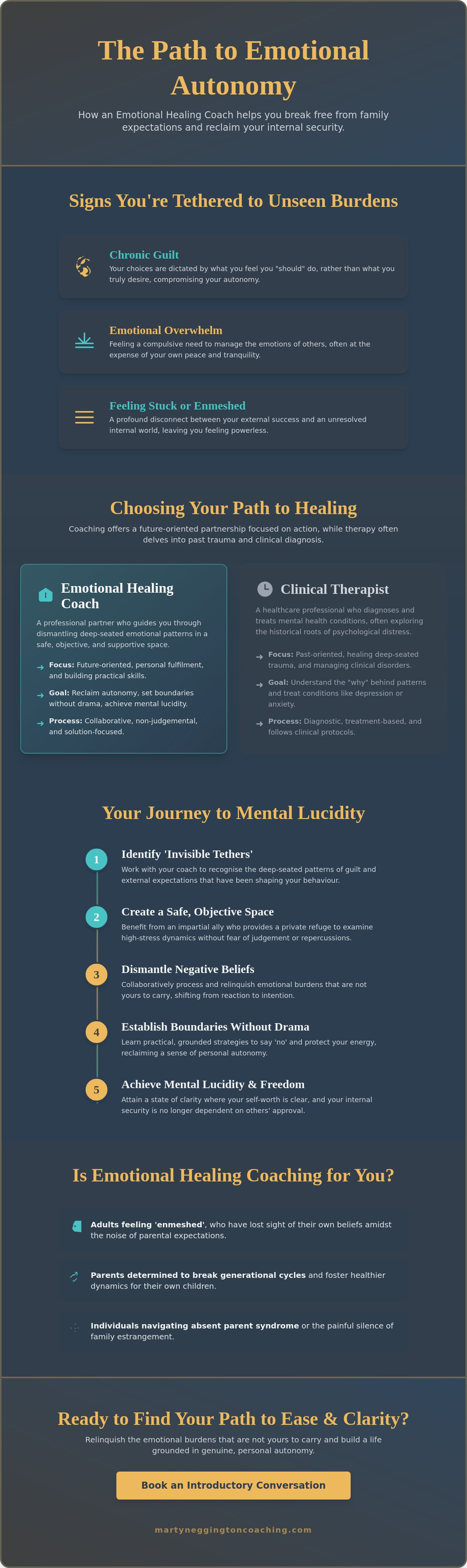
Emotional Healing Coach vs. Therapist: Choosing Your Path
Have you ever completed a course of clinical therapy only to find that, whilst you understand your history, you still feel unable to act upon that knowledge? This is a common experience for those navigating high-stress interpersonal landscapes. Understanding the boundary between these two disciplines is essential for your progress. While a therapist is a licensed professional trained to diagnose and treat mental health conditions, an emotional healing coach acts as a mentor and ally focused on future-oriented transformation. It's the difference between identifying a wound and learning how to walk with a new sense of freedom. It's about moving from insight to action.
Coaching is often the ideal choice for individuals who feel "stuck" in the aftermath of family trauma. You might have the intellectual awareness of why your family dynamics are difficult, but you lack the practical strategies to relinquish the emotional burdens that keep you reactive. A coach doesn't look at you through a clinical lens of pathology or diagnosis. Instead, they help you dismantle negative belief systems that were never yours to carry in the first place. This approach is active, practical, and progressive. It prioritises your internal security and tranquility over external demands, providing a framework for healing that is both rigorous and compassionate.
When to Choose a Specialist Life Coach
If your primary goal is to reclaim your identity and manage current family conflicts with mental lucidity, coaching provides the necessary tools. It's designed for the person seeking a clear path forward after years of enmeshment or estrangement. You aren't looking for a clinical observer; you're looking for a sense of internal security. By focusing on personal growth, you can learn to set boundaries that are firm, clear, and kind. This prevents the communication from becoming overly sentimental, allowing you to navigate family roles without the debilitating drama that usually follows.
The Collaborative Nature of Coaching
The "Safe Refuge" approach is built on a partnership of empathy and professional stability. Unlike the clinical distance often found in traditional settings, an emotional healing coach provides a collaborative environment where your needs are the central focus. They use reflective questions to help you uncover your own internal wisdom whilst offering steady, expert guidance. This process is gentle, patient, and thorough. It begins with a low-pressure entry point: a designated introductory conversation. This first step allows you to explore the possibility of significant change and mental transparency without the weight of an immediate commitment. It's about finding a steady hand to guide you as you move from the confusion of the past toward a future of personal autonomy and fulfilment.
How the Emotional Healing Process Unfolds
The journey toward internal security is rarely a straight line, yet it requires a logical framework to prevent you from feeling overwhelmed. An emotional healing coach provides this structure, moving you through a progressive series of stages designed to build mental and emotional transparency. This isn't about quick fixes; it's about a rhythmic, patient, and profound evolution of the self. By following a clear path, you can begin to untangle the knots of the past without losing your footing in the present.
Step 1: Establishing Mental Lucidity. We begin by identifying the root family patterns that have dictated your reactions for years. This stage is about seeing the "script" you've been handed with total clarity.
Step 2: Relinquishing Emotional Burdens. You learn the vital skill of giving back the guilt and expectations that do not belong to you. This is the moment you stop carrying weight that was never yours to bear.
Step 3: Dismantling Negative Beliefs. We examine the core convictions formed in childhood environments, such as the need for perfection or the fear of conflict, and systematically deconstruct them.
Step 4: Rebuilding Self-Worth. Through consistent, grounded, and validating support, you start to anchor your value in your own identity rather than external approval.
Step 5: Achieving the Ease, Clarity, Freedom Trio. The final objective is the integration of these shifts into your daily life, resulting in a sense of tranquillity that remains stable even during interpersonal stress.
Dismantling Negative Patterns
Do you often find yourself over-explaining your choices or anticipating others' needs before your own? These are frequently trauma responses rather than fixed personality traits. An emotional healing coach helps you organise your internal world so you can prioritise your own tranquillity over the demands of the family tree. Through a process of reflective questioning and direct guidance, you'll learn to recognise these automated behaviours. If you're ready to start this work, you can book an introductory conversation to explore how these steps apply to your specific situation.
Reclaiming Your Personal Autonomy
Finding your voice outside of family roles is a profound act of liberation. It involves discovering what you truly think, feel, and desire when the "invisible tethers" of parental expectation are removed. Reclaiming your personal autonomy means you can navigate high-stress landscapes without losing your centre. You develop the emotional resilience needed to maintain boundaries permanently, ensuring that your sense of peace isn't a temporary state but a lasting foundation. This is the essence of becoming who you were meant to be before the weight of external burdens took hold.
Finding Your Path to Ease, Clarity, and Freedom
How do you move from the heavy, confusing cycles of the past into a future defined by your own choices? Finding an emotional healing coach who understands the specific mechanics of family dynamics is often the final piece of the puzzle. Whilst self-help books and general wellness advice provide a foundation, personalised guidance remains the gold standard for achieving deep, lasting change. This is because your history is unique, and your path to mental transparency requires a bespoke approach that respects your individual pace and needs. It's about moving from a state of persistent confusion to one of profound internal security.
Transformation happens best in an environment where you feel entirely secure. You might prefer the quiet privacy of online coaching via Zoom, allowing you to process complex emotions from the comfort of your own home. Alternatively, for those who value physical presence, in-person coaching in London and Surrey offers a dedicated space away from the noise of daily life. These individual sessions can be further supported by workshops and digital products, creating a comprehensive ecosystem for your personal growth. The goal is always the same: to provide a steady hand as you transition away from survival-based behaviours.
The Martyn Eggington Approach
At the heart of this work is the "Safe Refuge" concept. This is specifically designed for adults navigating the painful landscape of family estrangement or the suffocating nature of enmeshment. By integrating 1:1 Coaching, the focus remains entirely on your internal security. This approach empowers adult children of absent or critical parents to stop reacting to old wounds and start becoming who they truly want to be. It is a process of reclaiming a self that has been hidden behind the needs of others for far too long. You are guided to relinquish the emotional burdens that were never yours to carry, allowing your true identity to emerge.
Taking the First Step
The first step toward healing shouldn't feel like another burden. This is why the process begins with a designated introductory conversation. This low-pressure entry point ensures a professional fit and allows you to experience the validation and objective distance that a specialist provides. What can you expect in your first session? You'll find a space defined by validation, objective distance, and a steady hand. The commitment is not to a person or a theory, but to your own growth and the eventual attainment of personal autonomy. You've spent enough time feeling tethered to the expectations of others; it's time to experience a future that is grounded, clear, and free.
Your Journey Toward Internal Security
Are you ready to stop managing the expectations of others and start living for yourself? The path to mental transparency begins with the simple act of choosing your own needs over external family demands. By identifying the root patterns of enmeshment or estrangement, you can finally relinquish the emotional burdens that have kept you tethered to a script you never wrote. An emotional healing coach provides the professional stability and objective distance required to navigate these high-stress landscapes with ease.
As a compassionate, non-judgmental ally with years of experience, I specialise in helping adult children reclaim their personal autonomy. Whether you prefer the privacy of online sessions via Zoom or in-person coaching in London, Dorking, or Shoreham-by-Sea, the focus remains on your internal security and tranquillity. You don't have to navigate this transition alone. Book your low-pressure introductory conversation today and take the first step toward a life of clarity and freedom. You've carried the weight for long enough; it's time to find your own centre.
Frequently Asked Questions
What exactly does an emotional healing coach do during a session?
An emotional healing coach uses a blend of reflective questioning and direct guidance to help you identify root family patterns and process negative beliefs. During a session, you'll work together to organise your internal world, ensuring your needs are prioritised over external demands. This collaborative process focuses on dismantling trauma responses and replacing them with intentional, grounded behaviours that support your personal autonomy.
How is emotional healing coaching different from clinical psychotherapy?
The primary difference lies in the objective: coaching is future-oriented and focuses on personal transformation, whereas clinical psychotherapy often involves diagnosing and treating mental health conditions. While therapy looks back to understand your history, coaching provides the practical strategies to help you move from being "stuck" to achieving mental lucidity. A coach acts as a mentor and ally rather than a clinical observer.
Can a coach help me if I am currently in the middle of a family estrangement?
Yes, a coach provides a safe refuge specifically for those navigating the complexities of family estrangement. They help you process the social stigma and personal grief whilst developing the emotional resilience to maintain your boundaries. The focus is on finding internal security and tranquillity, even when external conflicts remain unresolved or the silence from relatives feels heavy and permanent.
How long does the emotional healing process usually take to see results?
The duration of the process varies for everyone, as healing is a patient and progressive journey. Some individuals notice a shift in mental transparency after a few sessions, whilst others benefit from longer-term 1:1 coaching to dismantle lifelong patterns of behaviour. The focus is always on sustainable change and the removal of emotional burdens rather than rushed or temporary fixes.
Is it possible to heal from parental enmeshment without cutting off my parents?
It's entirely possible to heal from enmeshment whilst maintaining a relationship, provided you can establish firm, clear boundaries. An emotional healing coach helps you find your voice and identity outside of family roles, allowing you to stay grounded during interactions. You'll learn to relinquish the external emotional burdens that usually cause reactive behaviour, creating a sense of internal security that isn't dependent on their approval.
What if I feel too guilty to even start the coaching process?
Feeling guilty is a very common indicator of being tethered to parental expectations; it's often the very reason people seek professional support. This guilt is usually a learned response rather than a reflection of your character. The process is designed to be low-pressure, starting with a simple introductory conversation to validate your distress and explore the possibility of significant personal change without immediate pressure.
Can I do emotional healing coaching online via Zoom or must it be in person?
You can choose the format that feels most secure for you, whether that's online coaching via Zoom or in-person sessions. Face-to-face coaching is available in London, Dorking, and Shoreham-by-Sea for those who prefer a dedicated physical space away from their daily environment. Both options provide the same level of professional stability, compassionate guidance, and objective distance required for deep healing.
What are the signs that I have successfully healed from family trauma?
Success is often marked by a sense of internal security and the ability to set boundaries without debilitating drama. You'll experience mental and emotional transparency, where your own desires and goals are clear and no longer clouded by family conflict or parental criticism. Ultimately, you'll feel a sense of liberation as the weight of the past is removed, replaced by a future-oriented focus on your own fulfilment.


Comments